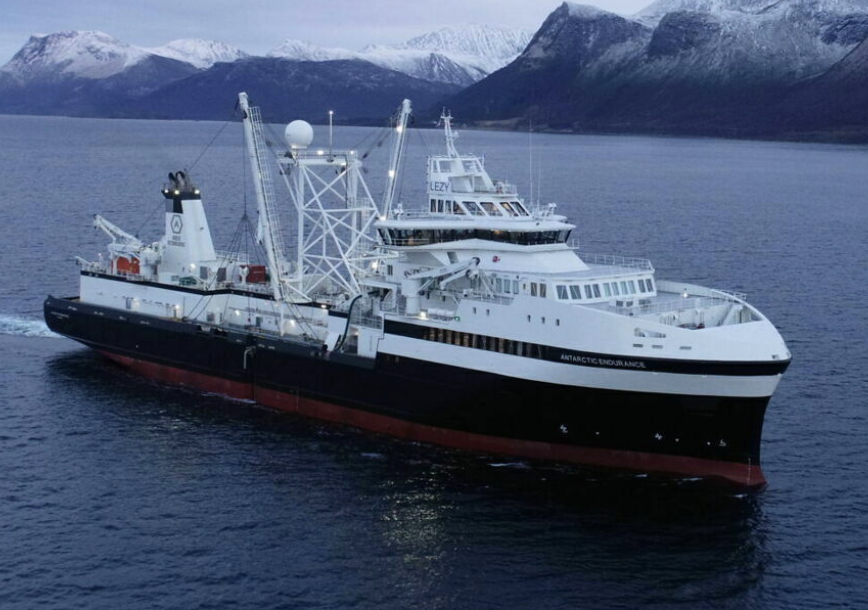
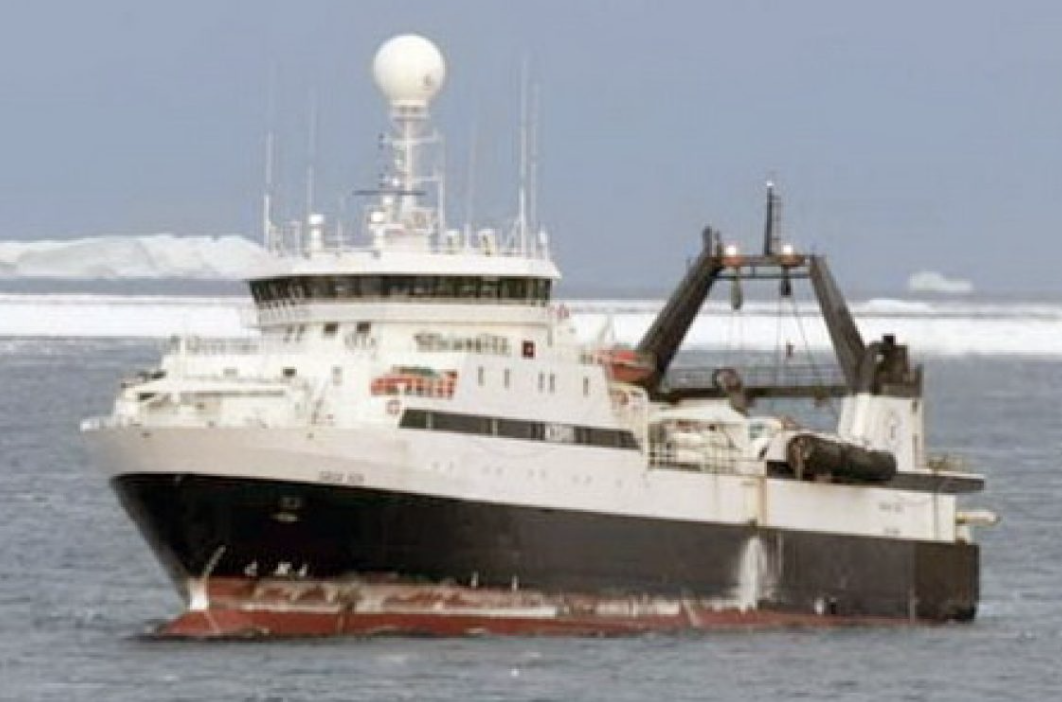
Krill are barely the size of a paperclip, but the entire Southern Ocean relies on them. This shrimp-like crustacean is a keystone species for the food web: it sustains whales, seals, penguins, and seabirds across the entire ecosystem. And yet, every year, industrial trawlers descend on this remote ecosystem to harvest it by the hundreds of thousands of tons, led overwhelmingly by the Norwegian company Aker BioMarine. With its two trawlers under the Norwegian flag, Antarctic Endurance and Saga Sea, it vacuums® out as much as 63% (1) of the total yearly krill catch.
But what's caught doesn't feed people. It becomes aquaculture feed for farmed fish on the other side of the planet, oil supplements such as omega-3, and pet food. Aker BioMarine is even the recipient of millions of dollars in subsidies (2) from the Norwegian government in order to remain competitive.
Zoom in, and the impact of that extraction comes into focus. Here, fishing regulations are set by the Commission for the Conservation of Antarctic Marine Living Resources (CCAMLR), which set an overall catch limit of 620,000 tonnes for krill. Aker BioMarine claims that since this is a small fraction of the total estimated krill biomass, the fishery is “sustainable”. But a focus on total catch limits obscures a much greater localized harm.
Fishing vessels cluster exactly where krill, and the marine predators that depend on it, are most concentrated: the West Antarctic Peninsula, the South Orkney Islands, and South Georgia. In 2022, fishing concentration there reached its highest level in 38 years (3). Industrial fishing can now rival what marine predators need (3), raising concerns that fishing is impeding the recovery (4) of whale populations from industrial whaling. This is in addition to climate change impacts already disrupting the delicate balance of Antarctic food webs. Calling a regional catch quota "sustainable" is meaningless if the harvest is happening in the one place the ecosystem is least resilient to it.
This crisis has a fix. It’s spatialization: dividing the fishing quota across sub-regions to spread out fishing pressure, and monitoring that pressure to prevent harmful impacts. CCAMLR used to do just this, until it failed to renew the existing rule in 2024. Now, the entire 620,000-tonne catch limit can be taken from anywhere within the zone. With no longer any spatial safeguards, the industry was able to accelerate. Aker BioMarine and others hyper-concentrated their catch around the Antarctic Peninsula, and in 2025, for the first time in history, the industry reached the catch limit (5) and the fishery shut down three months early. This year again, for the second time in a row, the fishing quota has been met.
Meanwhile, a proposal to establish the Domain 1 Marine Protected Area (MPA), a no-take zone around the Antarctic Peninsula where fishing pressure currently concentrates, has stalled for nearly a decade. Less than a handful of countries have repeatedly blocked its adoption at the annual CCAMLR negotiations.
Adopting spatialization measures and the Domain 1 MPA are two sides of the same coin: an Antarctic krill fishery held to the limits of what the ecosystem will bear.
What’s clear is who is benefiting from this: a handful of companies, Aker BioMarine foremost among them, are extracting a keystone species for economic benefit, so it can end up in a salmon pellet or supplement capsule.
- Krafft, B., Krag, L., Zhang, G., Menze, S., Ezequiel Aguirre, G., & Fuglseth Rasmussen, A. (2025). Antarctic krill and ecosystem monitoring survey off the South Orkney Islands in 2025. hi.no/en/hi/nettrapporter/toktrapport-en-2025-8
- Chavez-Molina, V., Miller, S., Teh, L., Sumaila, U. R., Francis, E., & Brooks, C. (2025). Do subsidies drive Southern Ocean fishery operations? A comprehensive analysis of Southern Ocean fishery subsidies and the economics of distant water fleets. Frontiers in Ocean Sustainability, 3, 1499494. doi.org/10.3389/focsu.2025.1499494
- Santa Cruz, F., Krüger, L., & Cárdenas, C. A. (2022). Spatial and temporal catch concentrations for Antarctic krill: Implications for fishing performance and precautionary management in the Southern Ocean. Ocean and Coastal Management, 223, 106146. doi.org/10.1016/j.ocecoaman.2022.106146
- Savoca, M. S., Kumar, M., Sylvester, Z., Czapanskiy, M. F., Meyer, B., Goldbogen, J. A., & Brooks, C. M. (2024). Whale recovery and the emerging human-wildlife conflict over Antarctic krill. Nature Communications, 15(1), 7708. doi.org/10.1038/s41467-024-51954-x
- Goodman, J. (2025, August 5). Krill fishery in Antarctica shut down after record catch triggers unprecedented early closure. The Associated Press. ap.org
Vessel tracks and fishing events: AIS data from Global Fishing Watch.
MPA boundaries: CCAMLR Domain 1 proposals, SGSSI MPA plan, South Orkney Islands MPA.
Krill density: adapted from GBIF.org (22 July 2026) | GBIF Occurrence Download
Whale occurrences: adapted from GBIF.org (17 February 2026) | GBIF Occurrence Download
Penguin occurrences: adapted from GBIF.org (20 February 2026) |GBIF Occurrence Download
Basemap: OpenStreetMap and CARTO.
Visualization
Basile Roth
Data mining
Zoé Borius, Hansa Mukherjee, Pierre-Louis Rey, Jérôme Bourdillon
Text & Review
Martin Binachon, Lila Sakata